Your ad platforms grade their own homework.
Compare connected ad platforms' conversion claims with orders recorded for your site. Stripe and Shopify payment records distinguish collected money from self-reported orders.
14 days free · no card · guided setup. USD reporting, no currency conversion; ad comparisons require compatible USD records. Hosted Meta activation and TikTok access are pending.
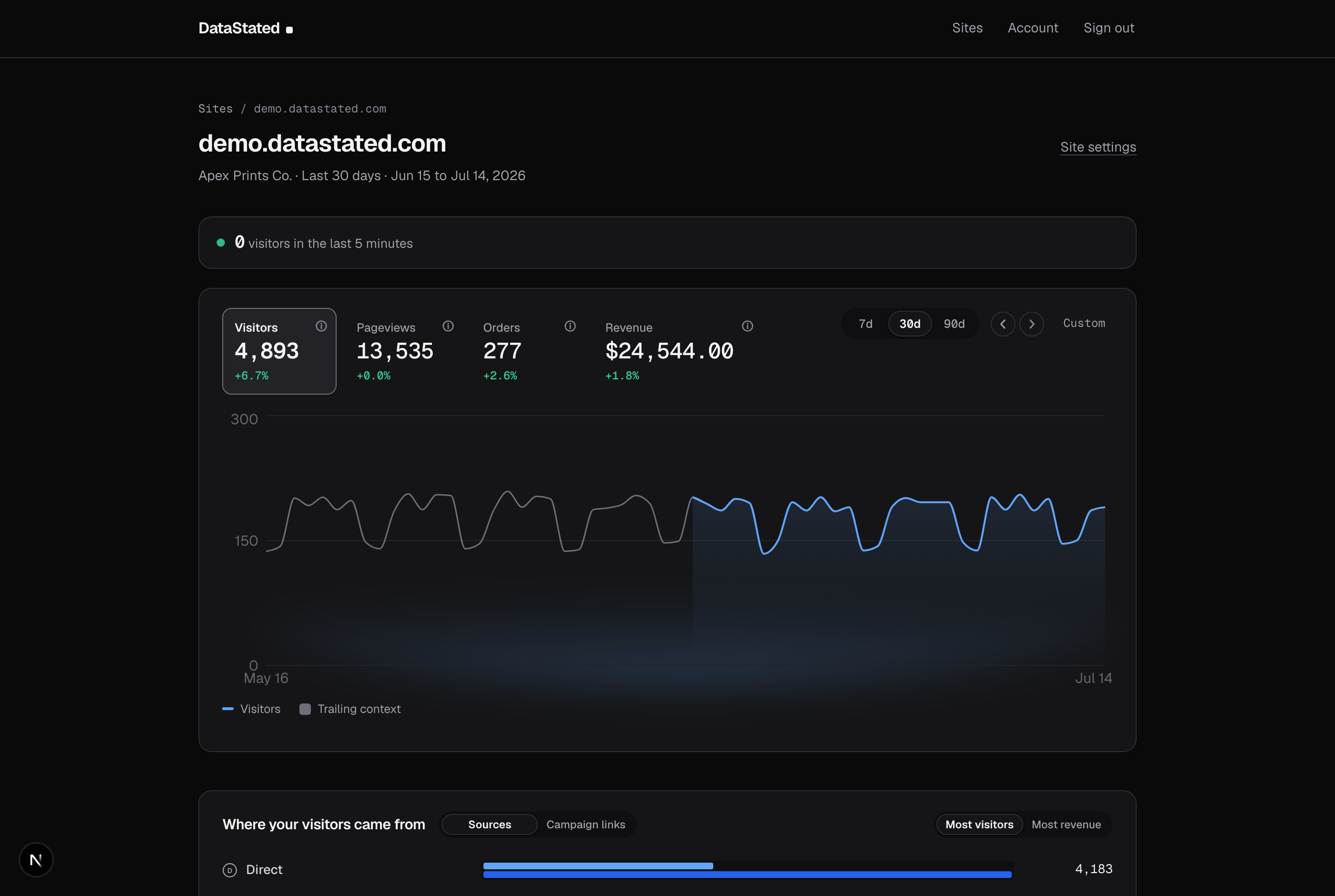
Every platform claims the same sale.
A customer clicks your Meta ad, searches your brand, clicks your Google ad, and buys once. Both platforms report the conversion.
Multiply that by every order and signup, every day, and nobody knows which channel is carrying the business. DataStated starts from what you actually sold and works backward.
How it works
-
Paste one line
Add your site, verify its domain, and install the tag with your consent controls. Shopify stores use the app's pixel. The setup guide walks through each step.
-
Your revenue becomes the referee
Bring in Stripe payments, Shopify order records, and goals from your site. Browser-reported orders and signups describe site activity; they do not independently confirm collected payment.
-
Spend where it's real
Compare platform claims with orders attributed to each paid channel. A gap can reflect attribution rules or missing tracking; use it to investigate before changing your budget.
Everything is included. On every plan.
AI assistants are a channel
People arriving from ChatGPT, Perplexity, Claude, and nine more AI assistants show up as real channels, not buried in "referral".
Ask it in plain English
Connect Claude, Cursor, or any MCP client and ask. A scoped API feeds your own scripts; a read-only key is one checkbox.
"How did Meta really do this week?"
Unlimited team seats
Invite your whole team, your cofounder, your freelancer. Seats never cost anything.
Your numbers through the API
Read analytics, orders, journeys and platform reports through the API, CLI and MCP server on every plan. The API reference lists each resource and its scope.
Works with or without your current analytics
DataStated stands alone. Keep GA4 running next to it if you want, and compare what each one tells you.
Works where you build
The tag is one line of HTML, so it goes anywhere HTML goes. Framework notes for all of these live in the docs.
Shopify stores skip the tag entirely: the app installs the pixel and brings the orders with it.
One plan. Your traffic sets the price.
Pick how many events your sites get a month. Nothing else changes your bill.
-
Room to outgrow your plan
Recording continues above your allowance up to your plan's recording ceiling. Your dashboard shows the included amount; upgrading reveals retained data beyond it. Events past the ceiling are dropped.
-
No feature hostages
Every feature, every integration, every seat, on the $9 plan and the $299 plan alike. The slider is the only difference.
-
Know how long history stays
History follows your plan's three- or five-year retention window. If every owner's access ends, recording stops after 30 days and analytics are removed after 90. Use the API while access is active, or email us about a data-copy request.
DataStated for AI agents
Connect Claude Code, Cursor, or any MCP client, or call the API from a script. Read documented analytics and manage supported resources within your key's permissions.
How is the store doing today, and did Meta actually earn its spend this week?
Checking your orders…
Today: 412 visitors, 9 orders, $1,284 collected Shopify orders. Instagram drove the most visits; your top page is /collections/new-arrivals.
This week Meta claimed 41 sales, $3,807 Meta Ads API. Your site recorded 17 orders, $1,536 attributed to Meta Ads Shopify orders. These are platform totals, not a match of individual claimed sales.
Why this exists
I run online stores and I build software. For years I paid Meta and Google for ads, and every month each one told me how much money it made me. Added together, they claimed more sales than my payment processor had ever seen. The tool that's supposed to settle this is Google Analytics, and Google also sells me the ads.
So I built the thing I wanted. DataStated starts from the orders you record on your site and in your payment system, and compares them with each connected platform's report. A payment without a matching visit stays unmatched, and example numbers are labeled.
It's a small product and I'm the one answering the inbox. If it ever tells you something about your money that isn't true, email me: hello@datastated.com.
Richard · founder, DataStated
Questions, answered plainly
What counts as an event?
Recorded pageviews, orders and goals count toward your event allowance. A signup counts when you send it as a goal. The total depends on what you track, and all your sites share one monthly allowance.
What happens when I go over my plan?
Your dashboard stays open and shows data up to your monthly allowance. Recording continues up to a plan-specific ceiling: 20 times the allowance on 10k and 100k, 15 times on 200k, 7 times on 500k, 5 times on 1M, 3 times on 2M, 2 times on 5M and 1.5 times on 10M. Beyond that ceiling, new events are dropped. Upgrading reveals retained data within the new allowance; it cannot recover dropped events.
Do I have to replace Google Analytics?
No. DataStated works standalone and needs nothing from Google, but it runs fine next to GA4. Many stores keep both for a while and decide after comparing.
How long do you keep my data?
Three years of history through the 200k plan and during the trial, five years from the 500k plan up. Automatic retention removes older analytics, with the record-specific exceptions listed in the privacy policy.
Does it only work with Shopify?
The tag works on sites where you can add HTML. On Shopify, the app installs a pixel and reads store order records. The Shopify guide explains event and payment coverage.
Is there a free trial?
14 days, every feature, no card. The clock starts when you create your account, and picking a plan early never costs you the rest: subscribe on day 4 and your card is first charged on day 15, when the free days end, not before.
Which plan do I need?
Answer two questions in the app, monthly pageviews and how many sites, and it recommends a size. A slider is right there if you disagree, and switching later is one click.
Do I need to know how to code?
The tag is a copy-and-paste install. You also verify ownership with a homepage meta tag or DNS record and connect any required consent controls. On Shopify the app installs its pixel. If someone else runs your site, share the setup guide with them.
What about GDPR and my visitors' privacy?
The tag uses a first-party cookie, with optional linking between domains you list. Ingest stores a daily-salted IP hash instead of the raw IP. The tag honours Global Privacy Control and Do Not Track. Your deployment still needs the appropriate notice and consent setup; see the consent guide, privacy policy and data processing agreement.
My site does not make money yet. Is it still useful?
Yes. Traffic, sources and goals work with zero revenue. The platform comparison needs connected ad reports and recorded orders; a signup goal does not become a paid order.
Can AI agents read my data?
Yes. Create an API key on your site's Settings → API tab, then connect Claude Code, Cursor, or any MCP client to app.datastated.com/api/mcp with it, and ask in plain English. The same key works for raw API calls from scripts. Keys see only your sites and are revocable in one click.
Can I invite my team?
Unlimited people, on every plan. Access is per site, so a freelancer sees the store they work on and nothing else.
Stop guessing which ads work.
14 days free. No card. Follow the setup guide to see your visitors and connect your revenue source.
Add my site